
Data integrity and the case for automated colony counting
Colony counting is so routine that it is easy to forget it is a measurement. An analyst looks at a plate, counts the colonies, and writes down a number. That number flows into microbial limit results, environmental-monitoring trends, water-system release, and bioburden decisions. And yet the entire measurement chain — the act of counting, and the act of recording — sits on two of the weakest links in the modern laboratory: human perception and the paper record. Automating colony counting is often framed as an efficiency play. It is more accurately understood as a data-integrity intervention.
Microbiology's structural data-integrity exposure
The microbiology laboratory is uniquely exposed to data-integrity risk, and the reasons are structural rather than cultural. The process is primarily manual: results cannot be generated automatically and depend on human judgment and recording, through a tedious procedure that is prone to omissions and errors. The level of automation lags well behind the analytical chemistry laboratory next door. There have historically been fewer regulatory guidelines governing the supervision of microbiology personnel. And the combination creates opportunities for both unintentional error and deliberate falsification.
This is not an abstract concern. Form 483 observations and warning letters citing data-integrity failures in microbiological testing — untraceable counts, missing raw data, records that cannot be reconstructed — have made the issue a live inspection risk. The governing expectation is the ALCOA+ framework, and its demands map uncomfortably onto manual colony counting:
- Attributable — every entry traceable to an individual via login, signature, and timestamp. A handwritten count in a logbook strains this.
- Legible and Enduring — readable and permanent over the retention period; faded ink and corruptible records fail it.
- Contemporaneous — recorded at the time of the activity, not reconstructed later from memory.
- Original — the first capture retained, whether printout, file, or image; any copy verified as true.
- Accurate , Complete , Consistent , and Available — free of error and omission, with all data including repeats and failures retained, in logical chronological order, and retrievable for audit.
PDA Technical Report No. 80 (Data Integrity Management System for Pharmaceutical Laboratories) and PIC/S PI 041 (Chapter 8.8) codify these expectations for the microbiology setting. Against them, a workflow that depends on transcribing handwritten counts from paper plates into a spreadsheet is exposed at nearly every step.
Where the manual workflow leaks
Tracing environmental monitoring as an example makes the leakage points concrete. The chain runs from planning and preparation, through sample collection, transfer, incubation, reading and counting, to approval and reporting — and each handoff introduces a characteristic failure. Paperwork and labels are prepared by hand, inviting writing errors on plates and sampling sheets. Samples collected from different locations are recorded on paper, with the risk of failing to adhere to sampling times. Plates move to the incubator, where loss or incorrect incubation cycles can occur. Reading is performed visually — typically by two analysts — with variability depending on who is reading. And then the results are transcribed from paper into electronic format for trending, a step that exponentially increases the risk of incorrect data each time it is repeated. The single most error-prone activities in the chain are the manual reading and the manual transcription — precisely the two steps automation eliminates.
The limits of human counting
Beyond data integrity, manual counting is simply an unreliable measurement under common real-world conditions. Counting large numbers of plates is labour-intensive and time-consuming, and operator fatigue introduces deviations and undermines reproducibility. The plate itself fights the analyst: aggregated or overlapping colonies cannot be accurately enumerated by eye; colonies that adhere to one another, sit at the margin, or overlap defeat consistent counting; tiny, colourless, or transparent colonies are easily missed; mould, culture-medium impurities, and condensation create interference; and colonies whose colour resembles the filter membrane disappear into the background. Layered on top is the problem of lag : counting results cannot be obtained rapidly during the early stages of culture, which prevents timely corrective or preventive action. The net effect is a measurement that varies with the analyst, the hour, and the plate — exactly what a controlled process should not tolerate.
What automation actually changes
Automated colony counting addresses both problems at once — the integrity of the record and the reliability of the count. The contrast is systematic. Manual counting takes minutes per plate; an automated counter delivers results in seconds. Manual batch processing requires marking and counting plates one by one, prone to fatigue; an automated system supports batch scanning, generates reports automatically, and connects directly to LIMS. Manual data recording is error-prone and liable to omission; automated systems save images and data with one-click export. On accuracy, manual results fluctuate with fatigue and experience, while AI-based recognition eliminates subjective bias to give objective, consistent results; intelligent segmentation distinguishes adherent colonies that humans miscount; and high-resolution imaging detects small or low-contrast colonies the naked eye overlooks. On traceability, manual work relies on paper records or phone photos that are difficult to verify, whereas automated systems archive the full image with an audit trail available at any time. The operational dividends follow: training that once took weeks compresses to under an hour on an intuitive interface, repetitive manual marking is replaced by automation that frees staff for analysis and decision-making, reports are standardized automatically, and remote review and collaboration become possible.
How the AI actually works — and why it is more than a camera
The credibility of an automated counter rests on its image-recognition model, and the modern approach is built on deep learning — specifically convolutional neural networks (CNNs). The method is methodical. First, a high-quality annotated dataset is constructed from large volumes of multi-scenario plate images, deliberately spanning different media types, lighting conditions, colony morphologies, growth densities, and background interferences. Second, the network is trained by supervised learning to distinguish genuine colonies from interferences — impurities, bubbles, scratches, and spreading growth. Third, after validation, the model performs real-time object detection or instance segmentation on new, unknown samples to count colonies objectively and traceably.
In practice, this lets the system separate adherent colonies and ignore the things that defeat a human or a naive threshold algorithm: printed codes, handwritten markers, logos, scratches, filter-membrane grid dots, and impurities. A particularly powerful refinement is time-lapse imaging analysis : by photographing each plate at intervals (for example, every hour throughout incubation) and tracking the dynamic morphological changes of growing colonies, the AI distinguishes true colonies from particulates based on how they change over time, segments cohesive colonies through their growth, and detects a colony as soon as it appears. The output is not a single number but a colony growth curve, a saved video of the growth process, and full image archiving — a born-digital, fully traceable record that satisfies ALCOA+ by construction rather than by retrofit. Demonstrations under adverse conditions — membranes, heavy condensation, water-vapour interference, insoluble impurities, and very high colony counts — show the approach holding up where manual counting degrades.
Two implementation patterns
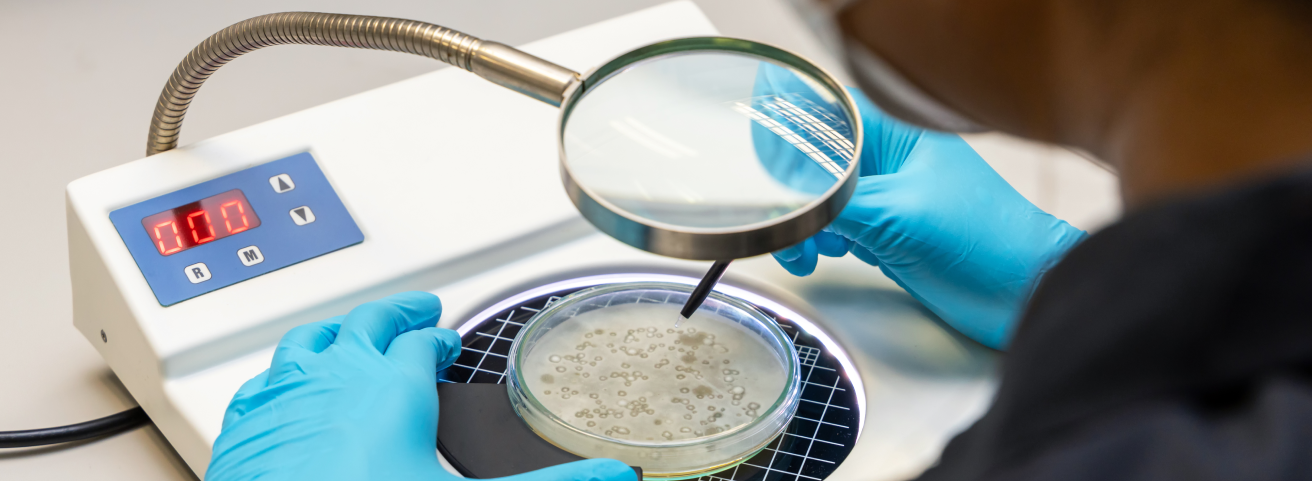
In practice, automated counting appears in two complementary forms. A scanning workstation combines automated incubation with real-time, continuous counting — imaging and counting each sample at regular intervals throughout the culture period, generating traceable reports and growth curves, and supporting batch processing across many plates. A bench-top automatic colony counter sits at the reading step: place a plate, and it counts in seconds with no clicking required, producing a traceable report that pairs the real photograph against the software-counted image alongside personnel and sample information, with LIMS upload. The first reduces hands-on time and captures the whole growth history; the second slots into an existing workflow at the point of reading. Both convert the count from a transient human judgment into a retained, auditable digital record, with three-tier electronic access control, audit trails, electronic signatures, and multiple export formats closing the data-integrity loop.
Conclusion
The case for automated colony counting is usually made on speed, and the speed is real — results in seconds, batches processed automatically, a tenfold efficiency gain in high-throughput settings. But the deeper case is about trust in the number. Manual counting is variable, fatigue-prone, and recorded in the most fragile way a laboratory still tolerates; it is the most common origin of the data-integrity findings that now dominate microbiology inspections. Automation, built on validated AI image recognition and born-digital records, replaces a subjective judgment captured on paper with an objective measurement captured with a full audit trail. In a discipline where the regulator has signalled that manual, paper-based microbiology is no longer good enough, moving from eyeball to algorithm is less an upgrade than an alignment with where compliance has already gone.
References